Barbara Henning
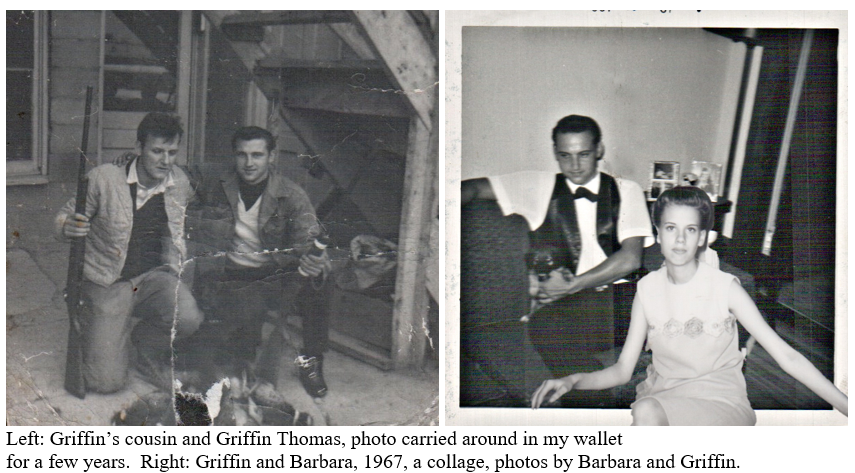
GRIFFIN
Once you rented a rowboat at the foot of Alter Road, and you took me out on the river. I didn’t yet know how to swim, and I was frightened of the undercurrent. The boat was shaking, big rain clouds were forming overhead. You laughed, shaking the boat to tease me. Once during the riots, you took me out into the country and taught me how to fire a shotgun. It knocked me flat. You and your cousin broke into stores on Woodward, and you brought home a new television set. I was appalled. You were good looking—black leather, waterfall haircut, Italian. You worked construction and you took me along with you to the bars around US Rubber where you knocked some pool balls around with your cousin until you snared in a sucker. I’d sit alone at a table waiting for you. Then home we’d go in your blow out car. When martial law was declared, we were in the Cinderella Theater on Jefferson Avenue watching The Good the Bad and the Ugly. Walking home, some guy made a remark, and you grabbed him, defending my honor and making him apologize for swearing in front of me. You taught me how to make spaghetti with only raw tomatoes, garlic, onions and olive oil. I tried to cook—but I didn’t know how—just things like frozen fish sticks. I did your laundry in the basement on a wringer washer, my hand and wrist passing through the rollers. You had secrets, many secret women, their numbers in little papers in your pockets. When I first met you, I had just turned 18 and you were 25. You picked me and my suitcase up from my father’s house in your souped-up black Plymouth with its big fins and loud motor. I didn’t yet know how to be a lover. We had sexed around. It wasn’t until we were living together, that you broke my hymen. A year later you broke my heart with a buxom Italian girl whose father bought you a house.
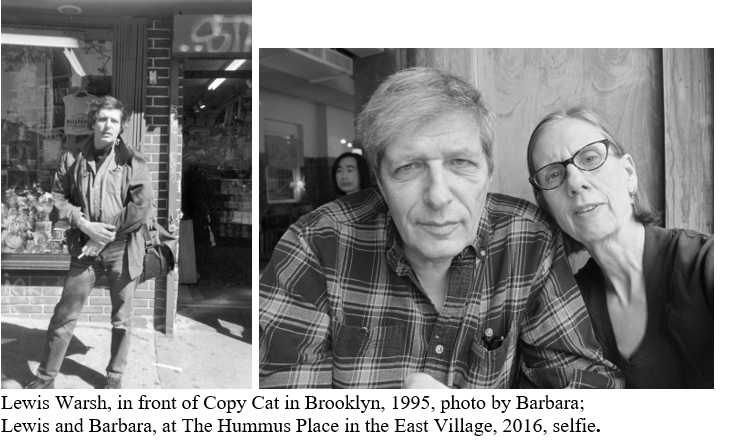
LEWIS
I arrived early for a faculty meeting at Queen’s College. A few minutes later, you came in the door, a tall skinny guy with messy hair, carrying an army surplus bag full of books. With the choice of many seats, you climbed up and sat beside me. Then we discovered that your name was already in my address book. A friend had suggested I contact you when I was settled in New York. I loved traveling around the city with you and our five children, your three and my two. We went with them to beaches and playgrounds and once to the Cloisters. We were very tight at first. Once when we were at Far Rockaway without the kids, we were rolled up in a blanket together, and you told me about the time you were walking down the street, and a woman fell out of a window, landing on the sidewalk in front of you. I remember walking with you on Canal Street. You were wearing a black overcoat with two missing buttons. Your hair was always a mess. I thought I’d be with you forever. Then something started to feel off track, out of sync. You told me you were seeing someone who had been your graduate student. Shattered. That’s how I felt at first. For years after that, we talked to each other on the phone every night. We helped each other through difficult break ups. In 2001, you married Katt. You were happy and I was happy for you. You and I used to meet for lunch at Angelicas Kitchen on 12th Street, most of the time sitting at the same table. I remember walking together under separate umbrellas, you on your way home to Chelsea and me to the East Village. You published three of my books, and I published one of yours. We worked on Long News together, and I helped you layout, type and proofread several United Artist books. In ’89, You spoke to Richard Hell at the Project about giving me my first reading at St. Marks. At LIU, we used to huddle together in your cubicle on the 4th floor, talking about books and people and poetry. You felt that we had done something very unusual by transitioning from lovers to a close friendship. When you were dying, you said to me over the phone, “I can’t get my fingers to work at all.” The body you were given was being taken away and you were worried about all the unanswered emails. “I’m going to miss you, Lewis,” I said. I can still hear the exact intonation of your reply. “Oh, Barb,” you said. At Greenwood Cemetery during the final months of Covid, a small group of us gathered and read Marge Piercy’s “Kaddish.” I looked up into the sky over the crematorium, and suddenly a big puff of black smoke shot into the blue. Sophia said, Dad always woke me up with a soft whisper.
Barbara Henning is the author of six books of prose and eight collections of poetry, most recently Girlfriend (Hanging Loose 2025); Ferne, a Detroit Story (Spuyten Duyvil 2023, Michigan Notable Book Award); Digigram (United Artists 2020) and Poets on the Road (City Point Press 2023 with Maureen Owen). Barbara lives in Brooklyn. She is Professor Emerita from Long Island University, and she presently teaches courses for writers.com. www.barbarahenning.com
Both poems were previously published in Hurricane Review.